
Dunno is the first answer. Can't find references to export numbering in the archive, but suspect they aren't numbered differently to the home market, as they came of the line in a line, if that doesn't sound stupid. Visual clue, which you probably have in front of you anyway for the very early ones, are the ornate almost art deco 'A' script in the bonnet chrome strip, and the small round number plate lamp in the centre of the rear bumper.Michelle wrote: ↑27 Feb 2026 16:26A related question: what and when were the *earliest* A40s?
I have a left hand drive one here in Canada, registered as a 1958.. and now I'm curious. The 'export or die' thing is also something I'd like to know about - were exported Farina bodies numbered differently?
Youngest A40
Re: Youngest A40
-
Dave the rave
- Posts: 1394
- Joined: 09 Nov 2019 20:19
- Location: Coventry
Re: Youngest A40
Didn’t the body number have a suffix/prefix denoting left or right hand drive 
If in doubt....kick the Ruskies OUT 

Re: Youngest A40
Thanks for the responses. Regarding the bonnet and rear light, this is my car:
- Attachments
-
-
-
Keith Bennett
- Posts: 1563
- Joined: 09 Nov 2019 21:40
Re: Youngest A40
Identifying the early Mk1s can be problematic, Michelle. Externally the four main clues are the "Flying A" termination at the front of the chrome centre strip on the bonnet (this was discontinued in 1959 after complaints from the American importer who regarded the protrusion as "dangerous"!), the button-like rear numberplate light in the centre of the rear bumper, the "golden arrow" A40 badge fitted to the right-hand side of the boot lid, and the lack of overriders on both bumpers.
Within the car, the two cast-iron identifiers are the body number (stamped irremovably into the shell just to the left of the windscreen wiper motor), and the car number (stamped on a removable plate screwed onto the 'A' passenger door pillar. Export cars' locations may differ.
Early cars are recognisable by the hurried manner in which Longbridge installed the boot area: no card side panels behind the rear seat to protect the rear lights' wiring, no internal boot floor (just rubber matting), and a vinyl protector for the spare wheel plus one single strap to support the open boot lid.
And the acid test for any original Mk1 lies in the rear frames for the two doors. That area on the very early cars was completely smooth below the door latch but stiffening creases were soon added when it was found that heavy slamming could distort the frame.
Sharp eyes may have spotted that "Gab" (my car owned since 1966) has a shell numbered 001633 which, when fitted out and completed became car number 2030 in August 1958. A-A2S6 was the Longbridge identifier for the A40 Farina model.
Here endeth the lesson!
Here endeth the lesson!
Re: Youngest A40
....and some lesson from the master.
-
Keith Bennett
- Posts: 1563
- Joined: 09 Nov 2019 21:40
Re: Youngest A40
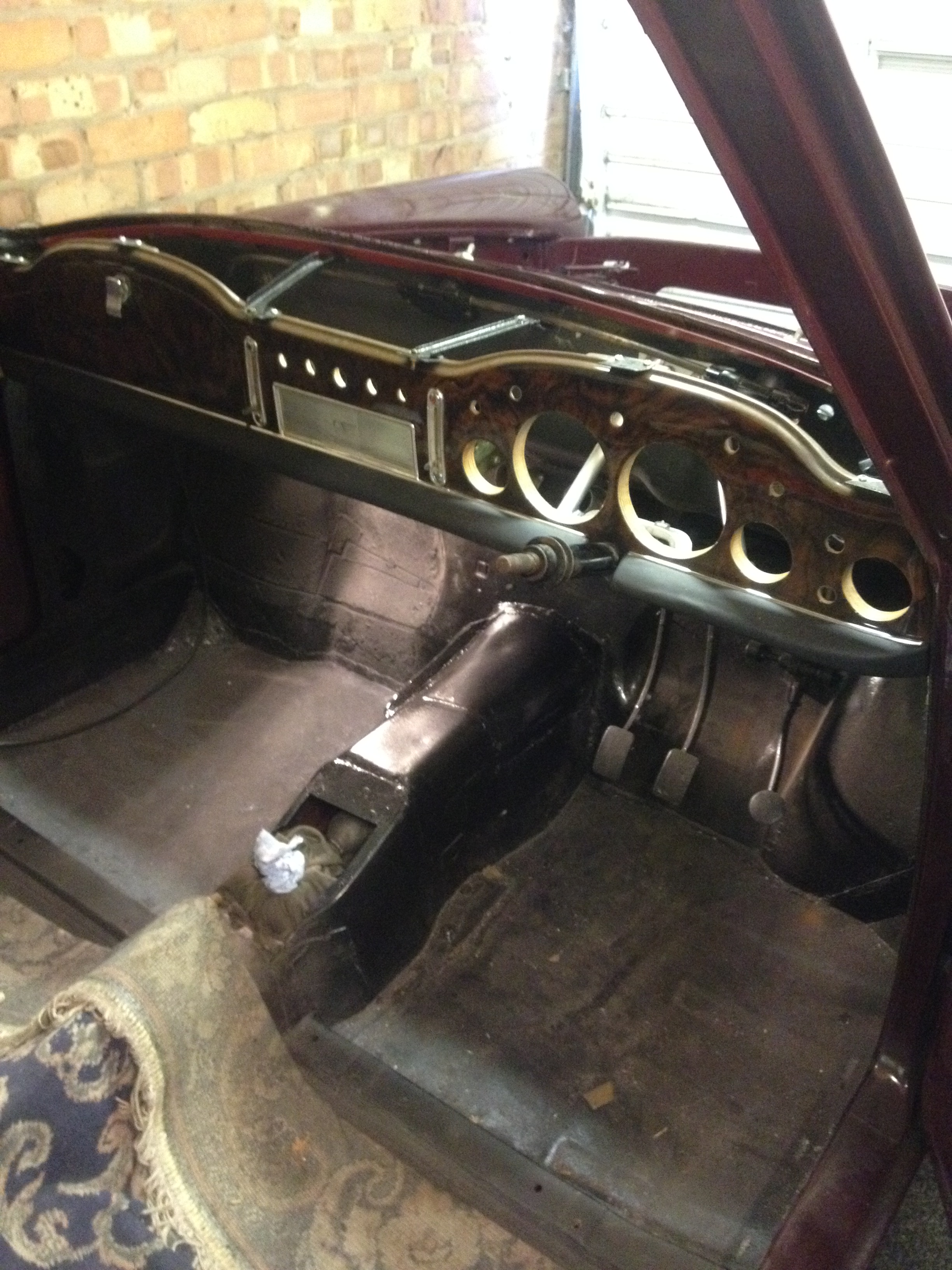
Who also forgot to mention the early indicator turn switch mounted centrally on the tin dashboard between the instrument light switch on the left, and the wipers' switch to its right.
The switch looks identical to the other two but rather than a vertical travel it is installed at 90° and thus operates to left, rest and right.
It was superceded by a 'tiller'-like rotating switch which, when operated, compressed a rubber bulb behind the dashboard to exhaust its air. A built-in very slow leak allowed air to re-expand it to the point where the switch would reset itself once the bulb assumed its normal shape.
The switch looks identical to the other two but rather than a vertical travel it is installed at 90° and thus operates to left, rest and right.
It was superceded by a 'tiller'-like rotating switch which, when operated, compressed a rubber bulb behind the dashboard to exhaust its air. A built-in very slow leak allowed air to re-expand it to the point where the switch would reset itself once the bulb assumed its normal shape.
-
Dave the rave
- Posts: 1394
- Joined: 09 Nov 2019 20:19
- Location: Coventry


Re: Youngest A40
Learn something every day KB, I was not aware of the little switch in the centre, a much nicer idea than the ugly black handle thing on mine.
-
austina40sam
- Posts: 1001
- Joined: 12 Nov 2019 20:43
Re: Youngest A40
Very interesting there Keith. 60 years with Gab this year.
-
Keith Bennett
- Posts: 1563
- Joined: 09 Nov 2019 21:40
Re: Youngest A40
Well, time passes and we all get older. Gab's original doors are still in the garage but by the mid-1970s they'd rusted out along the bottom skins and it was easier to buy two better ones from a car being broken for spares than to repair the originals. Same applies to that horizontal indicator switch: it's still in the drawer when its "snap" failed to work and it wouldn't hold position. Again, it was easier to put another switch on even though it didn't resemble the first one.
By the mid-seventies Gab was just a rusty old banger with a couple of thousand miles behind her (she was a company rep's transport and when I bought her she'd already covered over one thousand miles) and she was approaching the end of her active life, but some things could still be fairly easily fixed from donor cars.
What younger readers must realise is that back then, commercial repairers and body shops (certainly not the main dealers!) simply weren't interested in taking on work which might entail major body repairs with little chance of sourcing original panels (don't forget the internet was still light-years away) and I used to be quoted silly prices just to get rid of me.
But the classic car scene, once the preserve of the high-end and expensive 'quality' cars, was beginning to expand to include the humble family saloons and very slowly, specialists began to invest in remanufacturing service parts and simple body repair panels. This movement arrived just in the nick of time for Gab, and the pressure on keeping her roadworthy eased a bit.
With increasing interest in the classics came, unfortunately, scammers who offered their services but gave very poor quality work for high fees. I fell victim to one - but that's another story - and it so infuriated me to see my car reduced to a heap of junk that I was determined to see her back on the road, come what may. (The PDF called "Gab's Story" is freely available for download from this site if you're interested.)
Perhaps her next owner might consider returning her a little closer to original spec by repairing her old doors and the indicator switch - mind you, her first engine, gearbox and back axle are long gone - but for now, she's still a working girl driven most days in most weathers and earning her keep. And it's all due to Derek Minter and our Club's amazing spares service for giving us access to parts once almost impossible to source (I still recall standing at grubby trade counters amongst professional mechanics, waiting for the inevitable negative response from a bored, disinterested storeman. Mercifully those days are past). Our website is also a rich source of help and advice, and happily our A40s should last for many more years now. Thank heavens those bad old days are long gone. If only us humans could be fixed so easily . . .
By the mid-seventies Gab was just a rusty old banger with a couple of thousand miles behind her (she was a company rep's transport and when I bought her she'd already covered over one thousand miles) and she was approaching the end of her active life, but some things could still be fairly easily fixed from donor cars.
What younger readers must realise is that back then, commercial repairers and body shops (certainly not the main dealers!) simply weren't interested in taking on work which might entail major body repairs with little chance of sourcing original panels (don't forget the internet was still light-years away) and I used to be quoted silly prices just to get rid of me.
But the classic car scene, once the preserve of the high-end and expensive 'quality' cars, was beginning to expand to include the humble family saloons and very slowly, specialists began to invest in remanufacturing service parts and simple body repair panels. This movement arrived just in the nick of time for Gab, and the pressure on keeping her roadworthy eased a bit.
With increasing interest in the classics came, unfortunately, scammers who offered their services but gave very poor quality work for high fees. I fell victim to one - but that's another story - and it so infuriated me to see my car reduced to a heap of junk that I was determined to see her back on the road, come what may. (The PDF called "Gab's Story" is freely available for download from this site if you're interested.)
Perhaps her next owner might consider returning her a little closer to original spec by repairing her old doors and the indicator switch - mind you, her first engine, gearbox and back axle are long gone - but for now, she's still a working girl driven most days in most weathers and earning her keep. And it's all due to Derek Minter and our Club's amazing spares service for giving us access to parts once almost impossible to source (I still recall standing at grubby trade counters amongst professional mechanics, waiting for the inevitable negative response from a bored, disinterested storeman. Mercifully those days are past). Our website is also a rich source of help and advice, and happily our A40s should last for many more years now. Thank heavens those bad old days are long gone. If only us humans could be fixed so easily . . .